
Introduction
Running a small business requires managing many responsibilities at the same time. Business owners often handle marketing, customer support, accounting, sales, inventory, content creation, and daily operations with limited staff and resources. As competition continues to increase, finding ways to work more efficiently has become essential for long-term success.
Artificial intelligence has become one of the most valuable technologies for small businesses. Modern AI tools can automate repetitive tasks, analyze data, generate content, improve customer service, and assist with decision-making. Instead of replacing employees, these tools help teams work faster while allowing them to focus on more important business activities.

AI is more accessible than ever. Many platforms offer affordable pricing, easy setup, and cloud-based access, making advanced technology available even to startups and local businesses. From writing marketing content to managing customer relationships, AI tools can improve almost every part of a business.
This guide explores some of the best AI tools for small businesses, their key benefits, how to choose the right solution, and what the future of AI looks like for growing companies.
What Are AI Tools for Small Businesses?
AI tools for small businesses are software applications that use artificial intelligence to automate tasks, improve efficiency, and support better business decisions. These tools analyze information, recognize patterns, and perform activities that would normally require human effort.
Unlike traditional business , AI-powered platforms learn from data and improve their performance over time. They can generate written content, answer customer questions, organize information, predict trends, and simplify everyday operations.
AI solutions are available for marketing, accounting, customer support, project management, scheduling, email writing, and many other business functions.
How Do AI Business Tools Work?
AI tools use machine learning and natural language processing to understand data and complete tasks automatically. Users simply provide instructions or upload information, and the software generates useful results within seconds.
AI writing assistant can create marketing content, while an AI chatbot can answer customer questions at any time of the day. Other tools analyze sales reports, organize business documents, or recommend ways to improve productivity.
These capabilities reduce manual work and help businesses operate more efficiently without increasing staffing costs.
Why Are AI Tools Important ?
Small businesses often have limited budgets and smaller teams than large organizations. Artificial intelligence helps bridge this gap by allowing businesses to complete more work with fewer resources.
AI also improves customer experiences by providing faster responses, personalized recommendations, and better communication. As more companies adopt AI technology, businesses that ignore these tools may struggle to remain competitive.
Using AI strategically allows small businesses to improve efficiency while focusing more time on growth and innovation.
Best AI Tools for Small Businesses
There are many AI-powered business tools available today, each designed to solve different challenges. Choosing the right combination depends on your workflow, and business goals.

The following tools are among the most useful for small business owners.
ChatGPT
ChatGPT is one of the most versatile AI assistants available. It helps businesses create marketing content, answer customer questions, brainstorm ideas, write emails, summarize reports, and generate business documents.
Its conversational interface makes it easy for users without technical experience to complete a wide range of tasks quickly.
Many small businesses use ChatGPT to reduce writing time and improve daily productivity.
Why Businesses Choose ChatGPT
ChatGPT supports multiple business activities, making it valuable for teams with diverse responsibilities. It can assist with customer communication, product descriptions, business planning, and creative brainstorming.
Businesses also appreciate its ability to generate high-quality content within minutes.
Canva AI
Canva AI combines graphic design with artificial intelligence to help businesses create professional marketing materials without hiring a designer.
Users can generate social media graphics, advertisements, logos, and promotional content using simple prompts and ready-made templates.
Its AI-powered editing features speed up the creative process while maintaining professional design quality.
Best Uses of Canva AI
Canva AI is ideal for creating branded social media content, business presentations, promotional posters, and advertising graphics.
Its drag-and-drop interface allows even beginners to produce attractive designs quickly.
Small businesses benefit from reducing design costs while maintaining consistent branding.
Grammarly
Grammarly helps businesses improve written communication by correcting grammar, punctuation, spelling, and sentence clarity.
It also provides tone suggestions that make emails, reports, and customer messages sound more professional.

Many companies use Grammarly to improve communication quality across their teams.
Why Businesses Use Grammarly
Professional communication builds trust with customers and business partners. Grammarly reduces writing errors while improving readability and consistency.
Its browser extension also works across many websites and productivity platforms.
This makes everyday communication faster and more reliable.
Notion AI
Notion AI combines note-taking, project management, documentation, and artificial intelligence within one platform.
Businesses use it to organize projects, summarize meeting notes, generate reports, and manage internal knowledge bases.
Its collaborative features improve teamwork and simplify information sharing.
Business Advantages of Notion AI
Notion AI helps businesses organize information more efficiently while reducing repetitive administrative work.
Teams can create shared workspaces that improve collaboration and project tracking.
Its AI assistance also speeds up document creation and organization.
Jasper AI
Jasper AI is designed primarily for marketing and content creation. Businesses use it to generate blog articles, advertising copy, social media posts, product descriptions, and email campaigns.
Its templates simplify content creation for different industries and marketing goals.
Many marketing teams use Jasper AI to produce high-quality content consistently.
Why Marketers Prefer Jasper AI
Jasper AI focuses on persuasive writing and brand communication. It helps businesses maintain a consistent voice across different marketing channels.

Its AI suggestions also improve productivity for content creators and marketing professionals.
This makes it valuable for businesses that publish content regularly.
Benefits of Using AI Tools in Small Businesses
Artificial intelligence offers many advantages beyond simple automation. Properly implemented AI solutions improve productivity, customer satisfaction, and business growth.
Small businesses can achieve more with fewer resources by integrating AI into their daily operations.
Save Time Through Automation
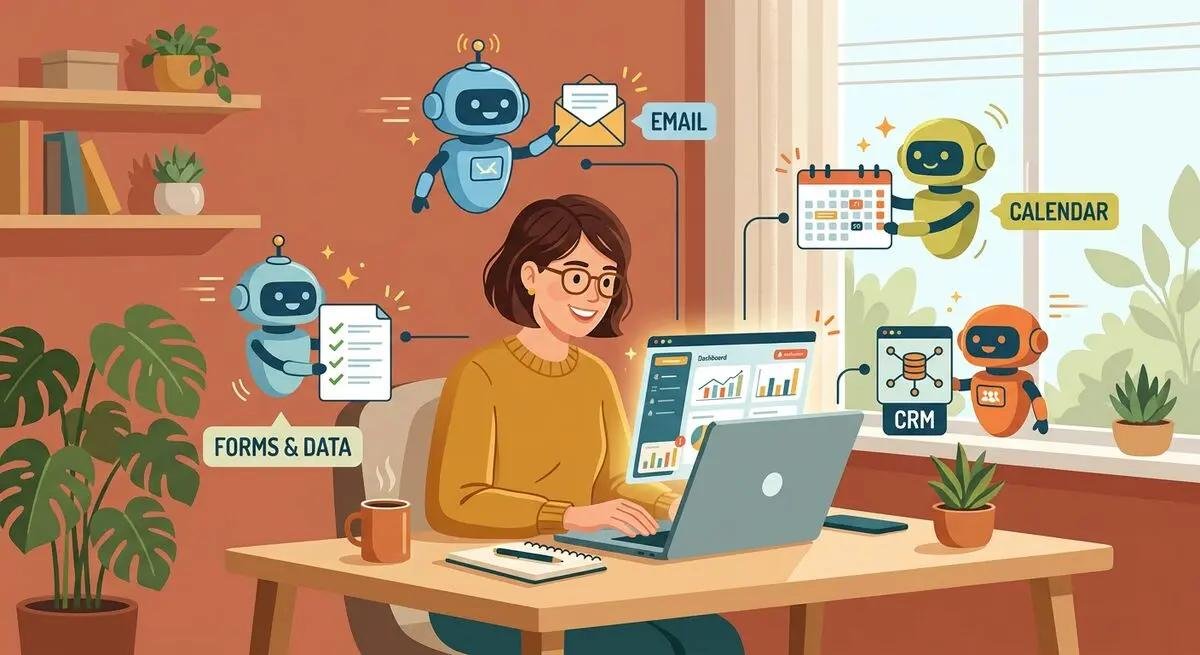
AI automates repetitive tasks such as writing emails, scheduling appointments, organizing documents, and responding to customer inquiries.
Employees spend less time on routine activities and more time focusing on strategic business goals.
Automation also reduces the likelihood of human error.
Improve Customer Service
AI chatbots and virtual assistants provide immediate responses to customer questions, even outside normal business hours.

Faster support improves customer satisfaction and helps businesses build stronger relationships with clients.
Consistent communication also enhances brand reputation.
Reduce Operating Costs
Hiring additional employees is expensive for many small businesses. AI software allows companies to handle larger workloads without significantly increasing staffing costs.
Many affordable AI tools provide enterprise-level capabilities at prices suitable for startups and small organizations.
This improves operational efficiency while controlling expenses.
How to Choose the Right AI Tool
Selecting the best AI software requires understanding your business goals and operational challenges. Different tools solve different problems.
Evaluating your workflow before making a decision helps maximize the value of your investment.
Identify Your Business Needs
Begin by identifying the tasks that consume the most time. Marketing, customer support, document management, and content creation are common areas where AI provides significant benefits.
Choosing software that solves real business challenges delivers better long-term results.
Avoid purchasing features that your business may never use.
Consider Ease of Use
A powerful AI tool should also be easy for employees to learn. Complicated software can reduce productivity rather than improve it.
Platforms with intuitive interfaces and helpful documentation are often the best choice for small businesses.
Simple onboarding also reduces training costs.
Compare Pricing and Scalability
Businesses should evaluate subscription costs alongside available features.
Choosing software that can grow with the business prevents the need for frequent platform changes as operations expand.
Flexible pricing plans also make budgeting easier.
Limitations of AI Business Tools
Although AI offers significant advantages, businesses should understand its limitations before relying on it completely.
Human expertise remains essential for many important business decisions.
AI Cannot Replace Human Creativity
Artificial intelligence can generate ideas and automate tasks, but it cannot fully replace human creativity, strategic thinking, or emotional understanding.
Businesses should use AI as a supportive tool rather than a replacement for experienced employees.
Human judgment remains critical for complex situations.
Data Privacy Considerations
Businesses often process sensitive customer information. Choosing AI platforms with strong security and privacy practices is essential.
Understanding how data is stored and protected helps reduce security risks.
Responsible AI usage builds customer trust.
Learning and Implementation Time
Introducing new software requires planning and employee training.
Although many AI platforms are user-friendly, businesses should allow time for proper implementation and workflow adjustments.
Gradual adoption often produces better results.
Future of AI in Small Businesses
Artificial intelligence will continue becoming more capable, affordable, and widely available for businesses of all sizes.
Future developments will further improve automation, decision-making, and customer engagement.
Smarter Business Automation
Future AI systems will automate increasingly complex workflows, reducing manual work even further.

Businesses will spend less time on administration and more time on innovation and customer relationships.
Automation will continue improving operational efficiency.
Better Decision Support
AI will become more effective at analyzing business data and predicting future trends.
Business owners will receive more accurate recommendations for marketing, sales, inventory management, and customer engagement.
This will support faster and better-informed business decisions.
AI Tools for Beginners, Startups, and Growing Businesses
Different businesses have different requirements depending on their stage of growth.
Selecting appropriate AI tools helps maximize productivity while avoiding unnecessary complexity.
For Beginners
New business owners should begin with simple AI tools for writing, design, scheduling, and document organization.
Easy-to-use platforms reduce the learning curve while delivering immediate productivity improvements.
Building AI skills gradually creates a stronger long-term foundation.
For Startups
Startups benefit from AI because small teams can accomplish more work with limited budgets.
Marketing automation, customer support, and content generation tools help startups grow more efficiently.
AI also allows founders to focus more on business strategy.
For Growing Businesses
Growing businesses require scalable AI solutions that support expanding teams and increasing workloads.

Project management, customer relationship management, and advanced analytics become increasingly valuable as companies grow.
Choosing scalable software supports long-term success.
FAQs
Are AI tools affordable for small businesses?
Yes. Many AI platforms offer free plans or affordable subscription options designed specifically for small businesses and startups.
Which AI tool is best for marketing?
Tools such as ChatGPT, and Canva AI are popular choices for creating marketing content, advertisements, and social media graphics.
Can AI replace employees?
AI is designed to assist employees by automating repetitive tasks rather than replacing human expertise, creativity, and decision-making.
Do small businesses need technical knowledge to use AI?
Most modern AI tools are designed for beginners and require little or no programming experience.
Is AI safe for business use?
Yes, provided businesses choose reputable platforms, follow security best practices, and protect sensitive customer information.
Conclusion
Artificial intelligence has become one of the most valuable resources for small businesses. By automating repetitive tasks, improving communication, supporting marketing, and organizing business operations, AI allows companies to achieve more while using fewer resources.
Tools such as ChatGPT, Canva AI, Grammarly, and Jasper AI provide practical solutions for businesses of all sizes. Each platform addresses different business needs, making it possible to build an efficient AI-powered workflow.
As AI technology continues to advance, small businesses that adopt these tools thoughtfully will be better positioned to improve productivity, reduce costs, and remain competitive in an increasingly digital marketplace.